Why Start-Up Marketing Fails | Business Reality vs Expectations
From Launch Excitement to Business Reality: Understanding the Psychology of Start-Ups, Marketing Expectations and the Importance of Accountability.
The Start-Up Reality Gap: Why Marketing Cannot Run Your Business for You
The psychology of launching a business, the difference between ambition and execution, and why marketing is only one part of commercial success.
Starting a business has never been easier in some respects. Websites can be built relatively quickly, brands developed, e-commerce platforms launched and marketing campaigns activated. Artificial intelligence has accelerated much of this process, allowing business owners to visualise their ideas and produce content at a speed that would have been unimaginable only a few years ago.
Yet there is an uncomfortable reality that we are increasingly encountering in the marketing industry.
Launching a business and operating a successful business are two very different things.
At Mini Media, we work with businesses at different stages of development. Some founders arrive with a clear proposition, a realistic understanding of their market and the discipline to follow through. Others have equally exciting ideas but underestimate the operational responsibilities that come after the website goes live.
There is nothing wrong with enthusiasm, ambition or dreaming big. Indeed, these are often the qualities that make entrepreneurship possible.
The problems begin when ambition becomes disconnected from the practical requirements of running a business, and when marketing is expected to compensate for everything that remains unfinished.
The Difference Between a Visionary and a Fantasist
Most successful businesses begin with an idea and someone who believes in it.
A visionary sees an opportunity that others may not recognise. They are prepared to invest time, resources and energy into turning that opportunity into something commercially viable.
But vision needs to be supported by execution.
There is an important distinction between an entrepreneur who imagines what a business could become and someone who becomes so absorbed in that imagined future that they neglect the work required to get there.
The first builds a business. The second risks building an expectation.
A business idea might have an impressive brand, an attractive website, ambitious revenue projections and a persuasive story. But none of these necessarily demonstrates that customers will buy, that products can be delivered or that the underlying business model is financially sustainable.
The essential questions remain:
- Is the product available, or is there a reliable supply plan?
- Can the business fulfil the orders it hopes to generate?
- Does the pricing support a sustainable margin?
- Is there sufficient working capital?
- Is the target customer clearly understood?
- Are the systems, processes and responsibilities in place?
- Has the proposition been tested against actual customer demand?
These are not simply marketing questions. They are fundamental business questions.
A good marketing strategy can communicate a viable proposition. It cannot make an unviable proposition viable simply by promoting it more effectively.
The Excitement of the Launch Versus the Discipline of Running the Business
One of the most recognisable patterns in new businesses is the excitement surrounding the initial launch.
There is a new company name, a logo, brand colours, a website and perhaps a social media presence.
Every milestone feels significant because the idea is becoming visible.
The website goes live. Congratulations are exchanged. Friends and colleagues visit. The business suddenly feels real.
Then something less exciting happens.
The business enters its operational phase.
- Stock must be ordered and paid for.
- Suppliers need chasing.
- Product information requires completing.
- Prices must be checked.
- Customer enquiries need answering.
- Sales processes need developing.
- Accounts must be maintained.
- Delivery arrangements need finalising.
A task list that initially contained a handful of exciting creative decisions becomes a growing collection of practical responsibilities.
And this is often where progress slows.
The website is finished, but the stock has not arrived.
The advertising campaign is ready, but the service cannot yet be delivered.
The marketing agency is waiting for essential product information, but the decisions remain outstanding.
Weeks pass, tasks carry forward, and the original momentum begins to disappear.
This is what we think of as the start-up reality gap: the distance between the business that has been imagined and the business that is operationally ready to trade.
It is not necessarily a lack of effort or intelligence. Founders may be overwhelmed, underfunded, inexperienced or simply trying to manage too many responsibilities at once.
However, those practical difficulties still need to be addressed.
A marketing agency cannot resolve them independently, particularly where decisions, resources and commercial authority remain with the business owner.
Your Marketing Agency Is Not Your Managing Director
This is perhaps one of the most important distinctions for any new business owner to understand.
A marketing agency can take responsibility for developing and delivering agreed marketing activities.
This might include branding, website development, SEO, paid advertising, content creation, social media, customer acquisition strategies and ongoing performance analysis.
A good agency will also challenge assumptions, identify weaknesses and offer commercial guidance where appropriate.
But that is not the same as running the company.
Marketing professionals are not automatically responsible for stock purchasing, supplier negotiations, operational staffing, order fulfilment, cash-flow management or deciding whether the business is genuinely ready to launch.
These responsibilities sit with the business and its leadership unless they have been expressly delegated under a separate arrangement.
Problems arise when the distinction becomes blurred.
For example, a business might expect its marketing agency to generate significant online sales, while the products being advertised are unavailable.
Or it might request a major lead-generation campaign before establishing who will answer enquiries, prepare quotations or convert those opportunities into customers.
When sales fail to materialise, the natural response can be to question the marketing.
But the more useful question may be whether the business was ready to convert the demand being created.
Marketing is responsible for helping attract and influence the right audience. The business is responsible for delivering the promise made to that audience.
Both sides have important responsibilities, and successful growth depends on them working together.
Building a Website Without Stock: The Difference Between Launching and Being Ready
There is nothing inherently wrong with launching a website before products are available.
Pre-orders, waiting lists, product previews and phased launches can all form part of a sensible commercial strategy.
However, they need to be intentional.
A pre-order business should communicate availability, expected delivery dates, purchasing conditions and customer expectations clearly.
A business collecting enquiries for a future service should explain when that service will become available.
The difficulty arises when a business promotes itself as fully operational without having the systems, stock or resources to meet the demand it is seeking to generate.
Consider a simple example.
A new online retailer invests in a professional website, launches Google Ads and begins attracting interested customers.
However, many products are unavailable, delivery dates remain uncertain and customer service processes have not been established.
The advertising may be working perfectly well in attracting relevant visitors.
But the commercial result is disappointing because customers cannot complete their purchases with confidence.
Increasing the advertising budget is unlikely to solve the underlying problem.
In fact, it may increase expenditure while exposing more customers to the same weaknesses.
Before increasing marketing activity, the business should establish what is preventing customers from buying.
Sometimes the most commercially valuable recommendation a marketing agency can make is not to spend more money on advertising, but to improve operational readiness first.
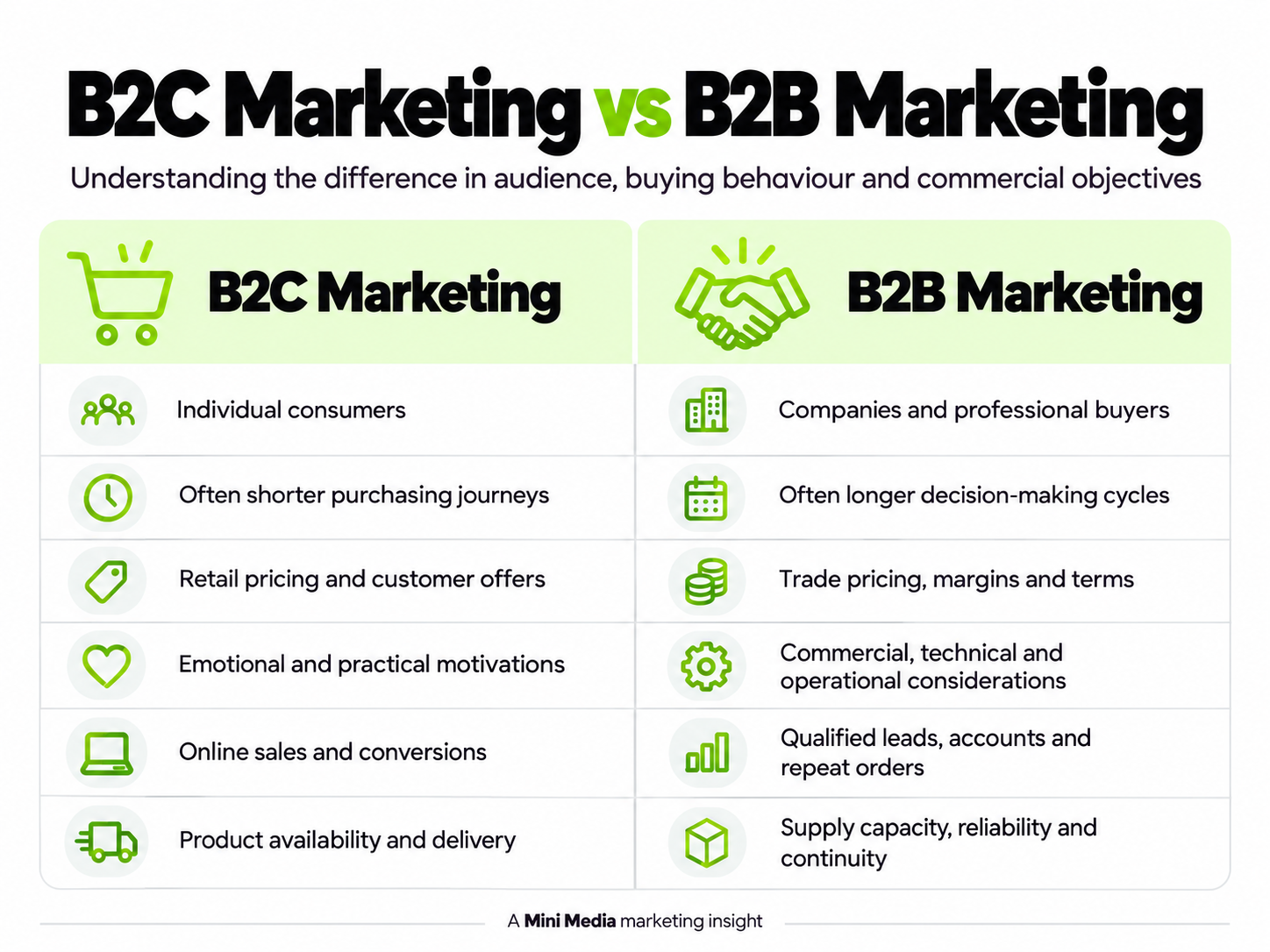
B2B and B2C: Two Different Buying Behaviours
Another issue we frequently encounter is the assumption that business-to-business (B2B) and business-to-consumer (B2C) marketing are simply two ways of advertising the same product.
They are not.
A product may appeal to both audiences, but the purchasing motivations, commercial relationships and decision-making processes can be very different.
Business-to-Consumer (B2C)
A consumer may be influenced by presentation, price, reviews, availability, convenience, delivery costs and emotional appeal.
For many consumer products, an effective website and advertising campaign can generate relatively direct purchasing decisions.
Customers may discover a product, compare alternatives and buy during the same online session.
This makes website usability, trust, product photography, transparent pricing and straightforward checkout processes particularly important.
Business-to-Business (B2B)
Business buyers generally assess a wider set of commercial considerations.
These might include wholesale margins, distribution arrangements, minimum order quantities, payment terms, reliability of supply, technical specifications, warranties, product certification and long-term commercial relationships.
A retailer considering stocking a new product may be less interested in an attractive social media campaign than in whether the supplier can maintain availability and provide a commercially attractive margin.
A distributor considering a substantial order may require several discussions, samples, technical information and internal approvals before making a commitment.
Brand awareness still matters in B2B, but it often supports a longer relationship-building and sales process rather than producing immediate online transactions.
Neither model is necessarily easier or more profitable.
The important point is to recognise that they require different marketing objectives, different sales processes and sometimes different website experiences.
A business can operate both models, but it must understand how each one functions.
Confusing brand awareness with sales generation, or consumer interest with wholesale demand, can lead to unrealistic expectations of what marketing should achieve.
The Psychology Behind It: The Karpman Drama Triangle
There is another dimension to these situations that we find particularly interesting: the psychology of responsibility.
In 1968, psychiatrist Stephen Karpman developed what became known as the Drama Triangle, a model used within transactional analysis to explore recurring patterns of conflict and dysfunctional interaction.
The model describes three roles:
The Victim: Someone who experiences themselves as powerless or unable to change their circumstances.
The Rescuer: Someone who feels compelled to solve another person's problems, sometimes assuming responsibilities that are not theirs.
The Persecutor: Someone who responds through blame, criticism or control.
These are patterns of behaviour rather than fixed personality types.
Individuals can move between roles as circumstances change.
Although the model was not developed specifically for marketing or entrepreneurship, it offers a useful way of reflecting on what can happen when a commercial relationship becomes frustrated.
Stage One: The Rescuer
A start-up founder approaches a marketing agency with an exciting idea and considerable enthusiasm.
The agency wants to help.
A website is developed, a strategy prepared and recommendations made. As the project progresses, the agency may begin helping with areas that extend beyond the original agreement.
It chases product information, reminds the founder about operational tasks, offers advice about stock management and attempts to keep the launch moving forward.
These actions can come from a genuine commitment to the client's success.
But if the agency continually assumes responsibility for unfinished business tasks, it can unintentionally create a dependency.
The founder starts expecting the agency to drive progress across the entire business.
The agency becomes The Rescuer.
Stage Two: The Victim
The business launches, but sales fail to meet expectations.
Stock is delayed, critical decisions remain outstanding or operational problems prevent customer orders from being completed.
The founder may begin to feel overwhelmed.
Marketing is expensive. Progress seems slow. The task list is growing.
The narrative can shift towards external obstacles:
- "The website isn't generating enough sales."
- "The advertising isn't working."
- "We've spent all this money and nothing is happening."
Some of these concerns may be legitimate. Marketing can underperform, agencies can make mistakes and strategies sometimes need to change.
But when operational limitations are ignored, the business may begin to view itself as powerless despite retaining control over many of the decisions required to move forward.
This resembles the Victim position in Karpman's model.
Stage Three: The Persecutor
As commercial pressure increases, frustration can turn into blame.
The founder may criticise the agency for failing to generate sales.
The agency, having spent considerable time trying to support the business beyond its agreed responsibilities, may become frustrated by the continued lack of action.
Suddenly, what began as a positive working relationship becomes an argument over who is responsible.
The business believes the marketing agency has failed.
The agency believes the business has failed to complete the necessary preparations.
Each side can feel unfairly treated.
The Rescuer may become the Persecutor. The founder may move between feeling powerless and assigning blame.
Meanwhile, the original problems remain unresolved.
The stock still needs ordering. The service still needs preparing. The pricing still needs agreeing. The sales process still needs developing.
And that is the most important lesson from the Drama Triangle: conflict can consume the energy that should be directed towards solving the underlying problem.
The model is a lens for understanding relationships, not a psychological diagnosis of business owners or a substitute for evaluating whether marketing has actually performed as promised.
Escaping the Triangle: Replacing Blame With Accountability
The alternative is not for a marketing agency to become detached or unhelpful.
Nor is it for a business owner to shoulder every responsibility without support.
The solution is to establish clear ownership, realistic expectations and a shared commitment to progress.
Instead of the agency trying to rescue the business, it becomes a professional partner.
Instead of the founder waiting for someone else to resolve the situation, they retain ownership of decisions and operations.
Instead of either party assigning blame, performance is measured against agreed objectives.
This requires some relatively simple disciplines.
Separate business tasks from marketing tasks
Every significant action should have a named owner.
If stock needs ordering, someone within the business must be accountable for ordering it.
If a website requires updated product descriptions, the agency may create or upload the content, but the business must provide or approve accurate specifications.
Agree what success actually means
A successful B2B campaign might generate qualified trade enquiries, sample requests or distributor meetings.
A successful B2C campaign might produce measurable online sales at an acceptable acquisition cost.
These are different outcomes and should be assessed accordingly.
Use operational milestones before increasing marketing spend
Before advertising heavily, confirm product availability, customer service capacity, delivery arrangements and the ability to fulfil orders.
Marketing expenditure should reflect commercial readiness, rather than simply enthusiasm for launching.
Review actions, not just aspirations
Regular meetings are valuable only when they lead to decisions and completed work.
A task list repeatedly carried from one meeting to the next is not evidence of progress.
The most useful questions are:
- What was agreed?
- What has actually been completed?
- What is preventing the next step?
- Who is responsible?
- When will it be finished?
Create room for constructive challenge
A good marketing agency should feel able to say when a business is not ready for a particular campaign.
Equally, the business owner should be able to challenge agency performance using agreed objectives and reliable evidence.
Professional accountability works in both directions.
Artificial Intelligence Has Made Starting Easier, but Not Running Easier
There is a further consideration in today's business environment.
Artificial intelligence has dramatically reduced some of the practical barriers to developing business ideas.
It can help create website content, visualise brands, draft business plans, analyse markets and support marketing production.
These capabilities can be valuable, particularly for smaller businesses with limited resources.
But there is a potential downside.
When creating the appearance of a business becomes easier, it can also become easier to confuse presentation with progress.
A convincing AI-generated business plan is not proof of demand.
An attractive website is not evidence of operational capability.
A sophisticated advertising campaign cannot guarantee customer satisfaction.
AI can accelerate tasks, but it does not automatically provide sound commercial judgement, supplier relationships, working capital or a viable business model.
In some circumstances, technology allows founders to move faster towards a launch before they have resolved the fundamentals.
The discipline required to operate the business remains.
And that discipline is rarely as visually exciting as launching a new website.
A Successful Launch Is a Starting Point, Not the Finish Line
Perhaps the greatest misunderstanding surrounding start-ups is the belief that once the website is complete and marketing begins, the business should naturally start generating consistent revenue.
The reality is considerably more complicated.
A website provides an opportunity to be discovered.
Marketing helps attract attention, develop trust and encourage buying decisions.
Sales processes convert appropriate opportunities into customers.
Operations deliver the product or service.
Customer experience determines whether buyers return, recommend the business or leave disappointed.
Financial management ensures the activity is sustainable.
All of these functions depend on one another.
A weakness in any one area can undermine the whole business, regardless of how effectively the marketing agency performs.
The strongest entrepreneurs understand this.
They do not expect their marketing partner to take ownership of the entire company. They recognise the value of expertise, make timely decisions, fulfil their responsibilities and remain engaged when the initial excitement fades.
They also accept that progress can be slower and more demanding than they originally imagined.
That willingness to move from enthusiasm into consistent execution is often what separates a promising idea from a sustainable business.
Our Perspective at Mini Media
At Mini Media, we enjoy helping ambitious businesses bring their ideas to life.
There is genuine satisfaction in seeing a new brand take shape, a website launch and a marketing strategy begin generating opportunities.
But experience has reinforced one important principle.
Marketing works best when it is supporting a business that is prepared to act on the opportunities it creates.
We believe in honest advice, clearly defined responsibilities and strategies based on commercial reality rather than unrealistic promises.
Sometimes that means recommending investment in SEO, paid advertising or brand development.
Sometimes it means advising a business to resolve its stock availability, pricing, sales process or operational capacity before spending more on promotion.
And sometimes it means having a difficult conversation about the difference between what a business hopes to achieve and what it is currently equipped to deliver.
Ultimately, successful marketing is a partnership.
The agency must take responsibility for the quality and effectiveness of its work.
The business owner must take responsibility for leading and operating the business.
Neither can reasonably be expected to succeed in isolation.
A website can launch a brand. Marketing can generate demand. But only a functioning business can consistently turn that demand into profitable, satisfied customers.
Mini Media – Practical marketing, honest advice and commercially focused digital strategies for growing businesses.