ASK Maps & the Future of Local SEO in the UK | Preparing Your Business for AI Search
ASK Maps & the Future of Local SEO in the UK
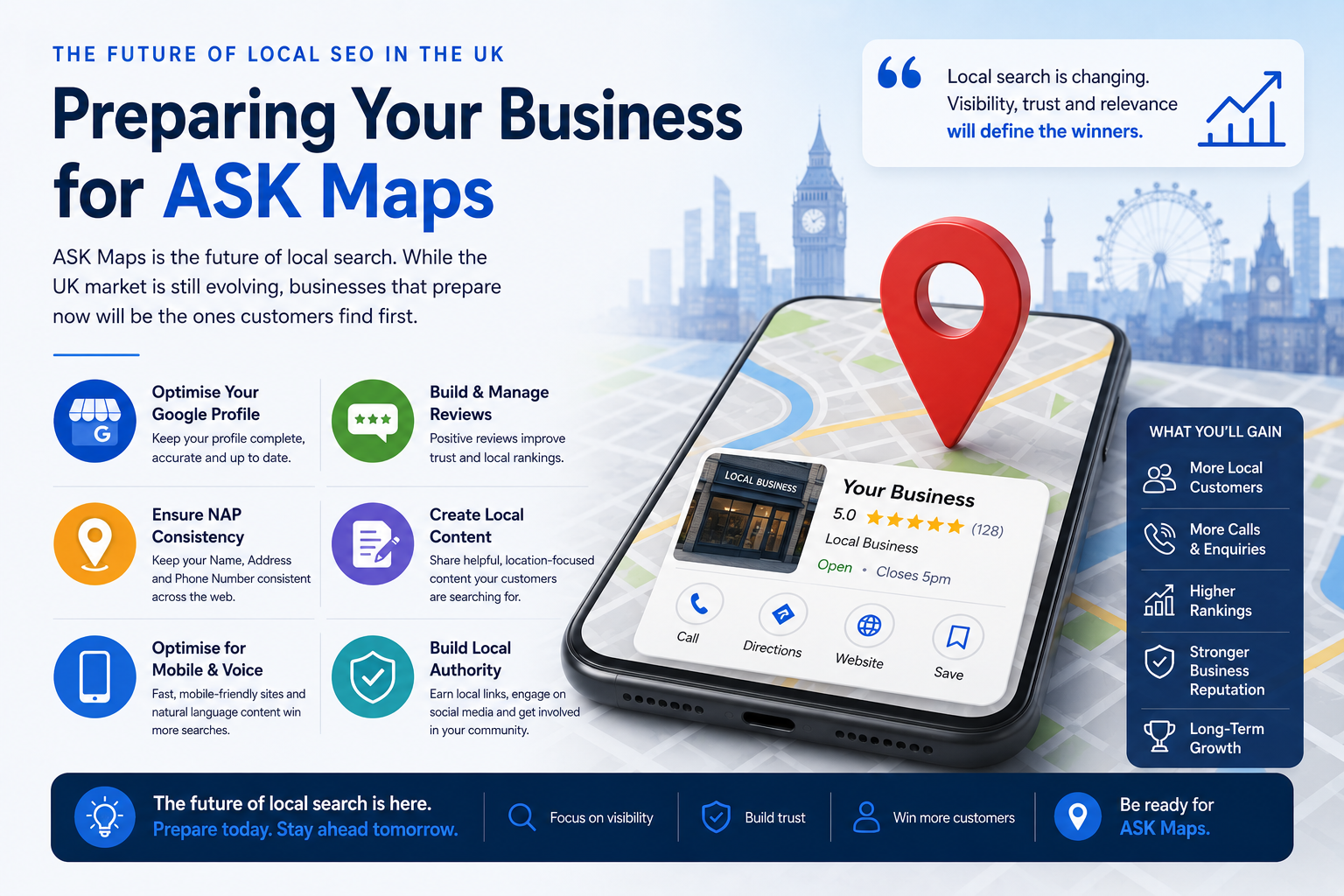
Local SEO is rapidly changing, and while ASK Maps is still an emerging concept within the UK digital marketing landscape, businesses should already be thinking ahead. Search engines are evolving beyond traditional website rankings and moving towards intelligent, map-based, AI-driven recommendations that prioritise trust, relevance, and local authority.
For UK businesses, this shift means one thing: local visibility will soon become even more important than standard SEO rankings.
Whether you run a construction company in Warwickshire, a café in Birmingham, a solicitor’s practice in London, or a retail store in Manchester, preparing for the future of local search now could give your business a major competitive advantage later.
What Is ASK Maps?
ASK Maps represents the next stage of local business discovery. While the UK market has not fully adopted ASK Maps technology or terminology yet, the concept reflects how search engines are moving towards AI-assisted local recommendations and enhanced mapping experiences.
Instead of relying purely on traditional keyword rankings, future local SEO will focus more heavily on:
- Business trust signals
- Location accuracy
- Customer reviews
- User engagement
- AI-generated recommendations
- Mobile and voice search
- Real-world authority
In simple terms, businesses that appear credible, active, and locally relevant online will dominate future search visibility.
Why Local SEO Is Becoming More Important
Google Maps and local search results already generate huge amounts of traffic for businesses across the UK. When customers search for services such as:
- “Builder near me”
- “Best coffee shop in Coventry”
- “Emergency plumber Warwickshire”
- “Hair salon open now”
Google prioritises local map results before standard websites.
This means businesses with strong local SEO strategies often receive:
- More phone calls
- More website visits
- More direction requests
- More enquiries
- Higher customer trust
As AI search develops further, this local-first approach is likely to become even stronger.
The Rise of AI in Local Search
Artificial intelligence is already changing how search engines interpret user intent. Rather than simply matching keywords, AI systems are learning to recommend businesses based on quality signals and user experience.
This means future local rankings may depend more on factors such as:
- Review quality
- Response rates
- Customer engagement
- Business reputation
- Consistent information online
- Relevant local content
- Social proof
Businesses that ignore these areas may struggle to remain competitive in future local search environments.
What UK Businesses Should Consider Going Forward
Optimise Your Google Business Profile
Your Google Business Profile is arguably your most important local SEO asset. Businesses with incomplete or outdated profiles risk losing visibility.
Key areas to focus on include:
- Accurate business information
- Updated opening hours
- Service descriptions
- High-quality images
- Service area targeting
- Regular updates and posts
Google wants to recommend businesses it can trust, and profile optimisation plays a major role in that.
Prioritise Customer Reviews
Reviews are no longer just reputation tools — they are SEO signals.
Businesses with consistent, genuine reviews typically rank better in local searches because reviews help search engines understand customer satisfaction and trustworthiness.
Going forward, UK businesses should focus on:
- Increasing review frequency
- Responding to reviews
- Encouraging detailed customer feedback
- Maintaining high star ratings
Review generation strategies may become one of the most important elements of future local SEO.
Ensure NAP Consistency
NAP stands for Name, Address, and Phone Number consistency across the internet.
If your details vary across directories, websites, or social platforms, search engines may lose confidence in your business information.
Businesses should regularly audit their:
- Website contact pages
- Google profile
- Social media accounts
- Directory listings
- Industry listings
Consistency helps improve local trust signals.
Create Location-Focused Content
Local content helps businesses establish geographic relevance.
Rather than creating generic SEO blogs, businesses should produce useful localised content such as:
- Area service pages
- Local project case studies
- Regional guides
- Industry advice for local customers
- Community involvement updates
This helps search engines associate your business with specific locations and services.
Prepare for Voice Search
Voice search continues to grow across smartphones and smart devices. People increasingly search conversationally using phrases like:
- “Who’s the best roofer near me?”
- “Where can I find a tax accountant nearby?”
- “Which café is open now?”
This means businesses should focus on natural language content and FAQs that answer real customer questions.
Focus on Mobile Experience
Most local searches now happen on mobile devices. If your website loads slowly or performs poorly on mobile, potential customers may leave immediately.
Businesses should ensure:
- Fast loading times
- Mobile-responsive layouts
- Easy click-to-call functions
- Clear contact information
- Simple navigation
User experience will continue influencing local search performance.
Build Authority Beyond Your Website
Future local SEO will likely reward broader digital authority, not just website optimisation.
This includes:
- Strong social media activity
- PR mentions
- Local backlinks
- Community engagement
- Industry partnerships
- Video content
- Customer interaction
Businesses that actively build their digital presence across multiple platforms may gain stronger visibility over time.
Why Early Adoption Matters
Many UK businesses still treat local SEO as an afterthought. However, as AI-powered search and map-based discovery evolve, competition for local visibility will increase dramatically.
Businesses preparing now may benefit from:
- Stronger local rankings
- Better customer trust
- Higher visibility in AI search
- Increased enquiries
- Improved long-term digital growth
Those waiting until local SEO becomes more competitive may find it harder and more expensive to catch up later.
Final Thoughts
While ASK Maps is not yet a fully established platform within the UK market, the direction of travel is clear. Search engines are moving towards smarter, more localised, AI-driven experiences that prioritise trusted businesses with strong digital signals.
For UK businesses, the future of SEO is no longer just about websites and keywords. It is about visibility, credibility, customer trust, and local relevance.
Companies investing in local SEO today will place themselves in a much stronger position for the future of search tomorrow.